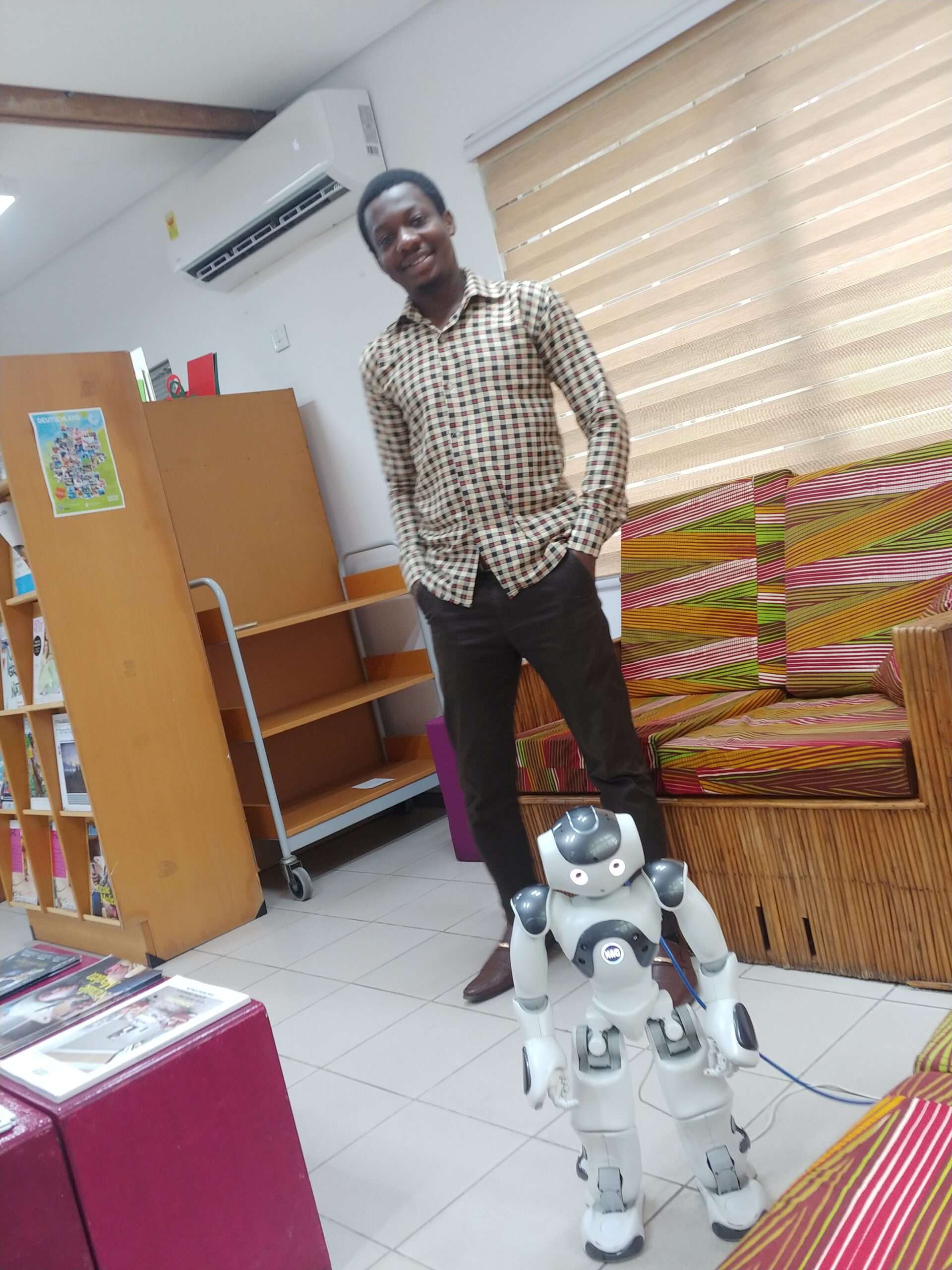
During my residency as a developer at the Goethe Institut-Accra in 2022, I undertook the task of building three robotic applications using the Naoqi Python SDK and Choregraphe framework. These applications aimed to enhance human-machine interaction capabilities by enabling dialogue, object identification, and motion control in static environments.
To achieve seamless human-machine dialogue, I leveraged the Naoqi Python SDK to develop algorithms for natural language processing and understanding. This involved implementing speech recognition and synthesis modules, enabling the robot to comprehend and respond to spoken commands and questions.

In the realm of object identification, I utilized computer vision techniques and the Naoqi SDK’s image processing capabilities. By employing advanced algorithms for object detection and recognition, I empowered the robot to identify and classify objects in its surroundings accurately.
In terms of motion control, I utilized the Choregraphe framework to design choreographies and behavior sequences. Leveraging my expertise in control theory and robotics, I programmed the robot to navigate and interact with its environment smoothly. This included creating algorithms for path planning, obstacle avoidance, and grasping motions.
To facilitate seamless integration of sensors and actuators, I developed data pipelines using the Naoqi Python SDK. This allowed me to establish reliable communication channels with the robot’s cameras, microphones, and motors, enabling precise control and data acquisition.
My contributions during this residency demonstrated my technical prowess in robotics, algorithm development, and integration of software and hardware components. By leveraging the Naoqi Python SDK and Choregraphe, I successfully built robust robotic applications with enhanced human-machine interaction capabilities.


